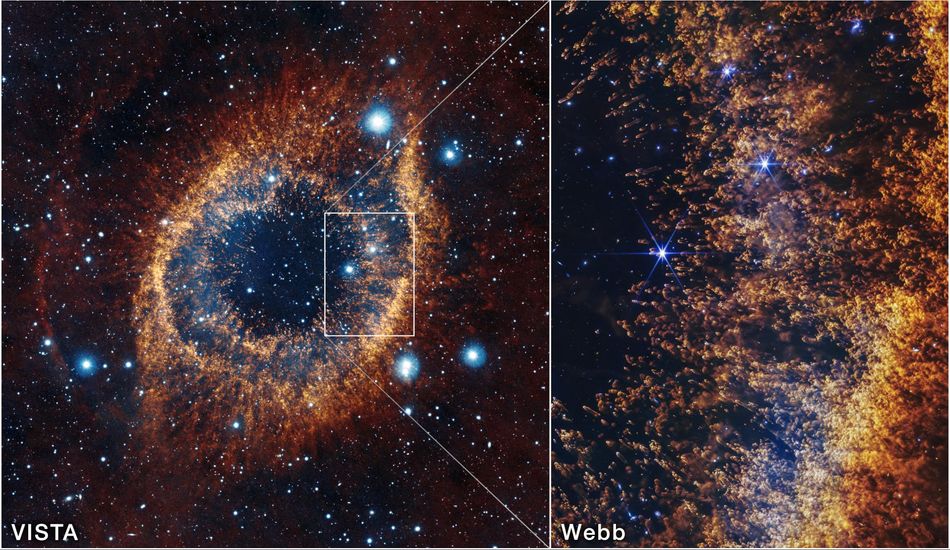
Webb Telescope Captures Stunning Details of the Helix Nebula, the 'Eye of God'
The Webb telescope has done it again, peering into the depths of the Helix Nebula, also playfully nicknamed the "Eye of God" or "Eye of Sauron". Seriously, who came up with these names? Anyway, this isn't just a pretty picture; it's a sneak peek into the future of stars like our own Sun.
This dying star is basically shedding layers of gas, like a cosmic snake shedding its skin. These materials are seeding the universe, providing the building blocks for new stars and planets. It's like the ultimate recycling program, but on a galactic scale.
Using its NIRCam (Near-Infrared Camera), the Webb focused on a small area of the Helix Nebula, revealing structures like comet-like knots and blazing stellar winds in all their glory. The images coming back are truly mind-blowing.
The high-resolution image reveals cloudy pillars that resemble flames engulfing the inner region of an expanding gas shell. Think of it as a cosmic demolition site where the stellar winds of hot gas collide with slower shells of gas and dust that the star discarded earlier in its life, creating the nebula's one-of-a-kind shape.
The white dwarf, the core of the dead star, sits at the heart of the nebula. The radiation released from the dying star illuminates the surrounding gas and generates layers of material, which resembles cosmic lasagna. Closest to the white dwarf is hot ionized gas, with colder molecular hydrogen farther out. Inside the dust clouds are safe pockets where more complex molecules can develop. These are the raw materials that might eventually shape themselves into planets and star systems.
What's particularly cool is how the image uses color to represent the material's temperature and chemistry. The blue color represents the hottest gas, which is energized by powerful ultraviolet light from the white dwarf. The gas cools to produce yellow regions where hydrogen atoms merge into molecules as you move further away. Reddish tones denote the nebula's outermost edges, where thinning gas gives way to dust production, according to NASA.
This nebula, first spotted way back in the 1800s, has become a real icon because of its distinct shape and proximity to us – it's only 650 light-years away in the Aquarius constellation. I mean, in cosmic terms, that's practically next door!
Astronomers have been studying this "Eye of Sauron" for ages, using both ground-based and space telescopes to get a detailed look at a star's final moments. And with Webb's incredible capabilities, we're getting an unprecedented view of this fascinating process. If you ask me, it's really exciting!
1 Image of Helix Nebula:

Source: Gizmodo