Stellar Collision Course: A Supernova Bright Enough to See During the Day
Okay, so picture this: a cosmic sibling rivalry taken to the absolute extreme. I'm talking about a pair of stars locked in a deadly dance, with one cannibalizing the other. And get this – it's all happening in a system called V Sagittae, a mere 10,000 light-years away.
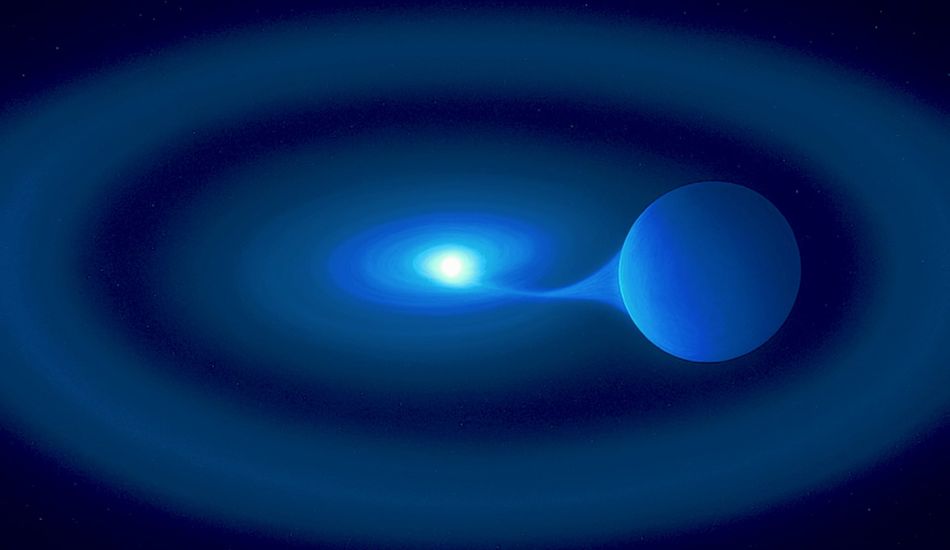
Scientists have been scratching their heads about V Sagittae's unusual brightness for over a century. Now, it seems they've cracked the code: a super-dense white dwarf is basically feasting on its larger companion star at an insane rate. Think of it like a glutton at an all-you-can-eat buffet, but instead of chicken wings, it's devouring stellar material.
What's the end game? Well, according to a study published in Monthly Notices of the Royal Astronomical Society, these two stars are destined for a head-on collision. And when they finally smash together, it's going to be one heck of a show. We're talking about a supernova so bright, it'll be visible from Earth, even during the day. Talk about a cosmic fireworks display!
A Stellar Mystery Solved
You know, it's amazing how much we can learn by observing these distant objects. Researchers used the European Southern Observatory's Very Large Telescope in Chile to study V Sagittae. What they found was mind-blowing. There's a giant ring of gas surrounding the stars, made up of debris from all the stellar carnage. It's like the universe's version of leaving the toilet seat up.
One of the researchers, Pasi Hakala, pointed out that the white dwarf can't consume all the mass it's stealing from its twin. That's what creates this bright cosmic ring. It's a sign that this stellar system is heading for a violent end. I think it's pretty incredible that scientists are able to predict these events with such accuracy, right?
Before the grand finale, another researcher, Pablo Rodríguez-Gil, suggests that the white dwarf will likely trigger a nova outburst. A nova is like a mini-explosion in a binary star system, and this one would be bright enough for us to see without needing telescopes. So, keep your eyes peeled, folks!
While I'm not an astrophysicist, it's really cool to think about how studying these far-off events can help us understand the bigger picture of how stars are born, live, and eventually die. Plus, the thought of witnessing a supernova visible in broad daylight? I mean, that's something I don't want to miss. Let's just hope it happens soon!
Source: Gizmodo