Runaway Black Hole Creates Stars While Speeding Through Space
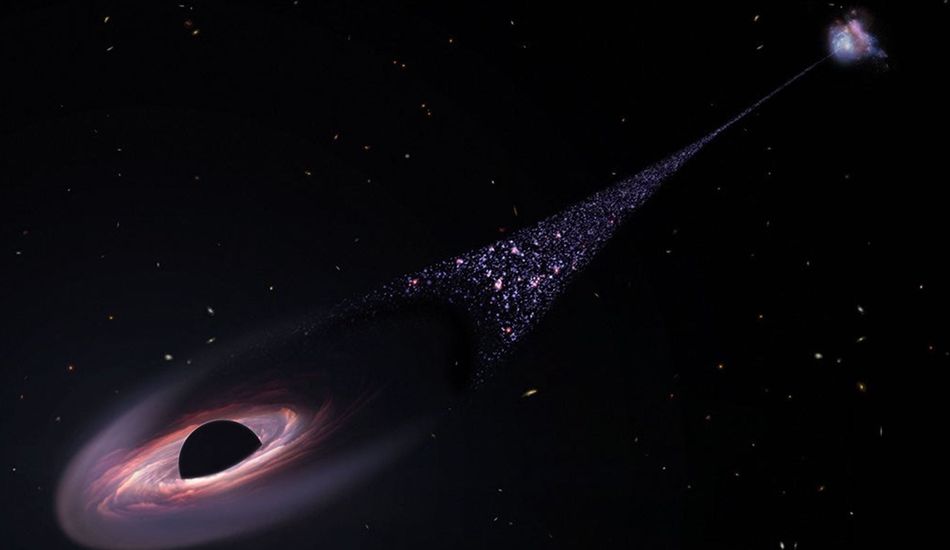
Okay, so picture this: a supermassive black hole, I mean, seriously huge – we're talking 10 million times the Sun's mass – just tearing through space. But it's not just cruising; it's leaving a trail of gas in its wake, and that gas? It's turning into baby stars. It's like some cosmic Johnny Appleseed, but instead of planting apple trees, it's scattering the ingredients for new suns.
Astronomers have been theorizing about these runaway black holes for ages, but actually spotting one? That's brand new. The Webb telescope, bless its gold-plated mirrors, confirmed this cosmic renegade. It's hauling at an insane 2.2 million miles per hour. To put that in perspective, it could zip from Earth to the Moon in about 14 minutes. I can't even make coffee that fast.
The initial observation of a bright streak – a cosmic breadcrumb trail, if you will – happened last year using the Hubble telescope. Webb then stepped in to confirm that, yeah, it's a black hole on the lam. And the reason behind that bright streak? As the black hole barrels through space, it slams into gas, creating a bow shock, like when a boat speeds across water. The gas heats up, and boom, new stars are born.
Usually, black holes are like the mayors of their galaxies, chilling at the very center. This one, though, is about 230,000 light-years away from its home. That's like moving from New York to... well, a galaxy far, far away. It must've been going at some serious speed to break free from its galaxy's gravitational grip.
How did this even happen?
So, how does a black hole stage a jailbreak like this? The prevailing theory is a galactic merger. Two galaxies smashed together, and the resulting chaos gave the black hole a mega-kick, sending it flying. Or, imagine two galaxies merging, and one had a pair of black holes already doing the tango. Add a third black hole to the mix, and suddenly, things get unstable. Think of it like trying to juggle three chainsaws – someone's gonna end up on the losing side and getting flung out.
One of the researchers, Pieter van Dokkum from Yale, put it best: "It boggles the mind!" And I have to agree. The amount of force required to dislodge something that massive is truly staggering. But hey, science predicted it, and now we're seeing it in action. It's a crazy universe out there, and I, for one, am here for it.
Source: Gizmodo