Monster Planet-Forming Disk Dubbed Dracula's Chivito Spotted
So, I stumbled upon some pretty wild news from the cosmos. Astronomers have spotted this absolutely massive disk of gas and dust swirling around a young star, and get this – it's churning out planets! It's not just big, it's record-breakingly large, and its behavior? Totally off the charts compared to anything we've seen before.
We're talking about a disk that stretches nearly 400 billion miles wide. To put that into perspective, that's 40 times the size of our entire solar system. Can you even wrap your head around that? I mean, our solar system suddenly feels like a tiny pebble in comparison.
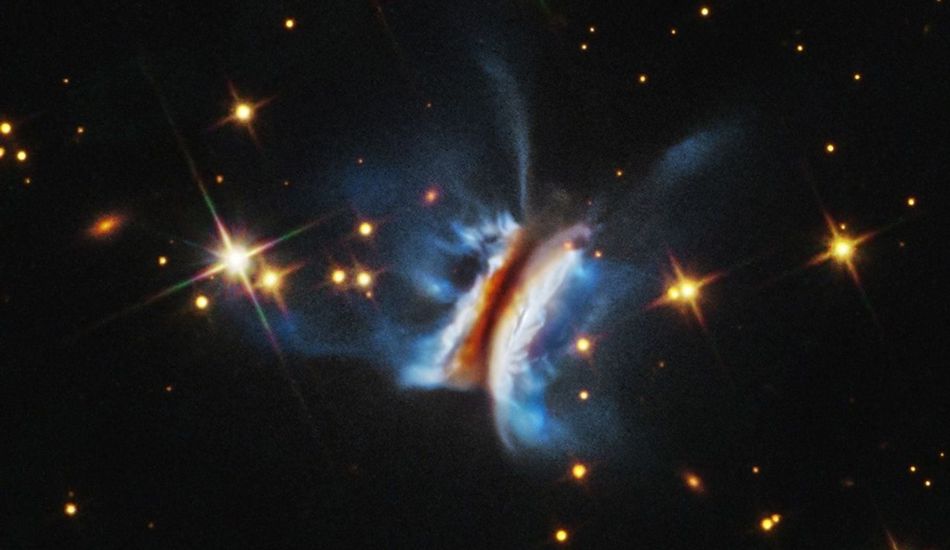
While this behemoth was initially spotted back in 2016, it's only now that astronomers have managed to snag the first visible light image of this planetary factory, thanks to the trusty Hubble Space Telescope. And what they saw is, well, let's just say it's not your average, run-of-the-mill space scene.
Chaotic Planet Formation
The images reveal a chaotic environment. We're talking about wisps of stuff stretching way beyond the expected boundaries of the disk. It's like the universe is throwing a party and things are getting a little out of hand, you know? But here's the kicker: these filaments are only hanging out on one side of the disk. What's up with that?
Now, the astronomers, being the clever folks they are, decided to give this thing a nickname: "Dracula's Chivito." It's a nod to the heritage of two of the researchers, one from Transylvania and the other from Uruguay. When you look at it edge-on, the planet-forming disk looks like a sandwich, with a dark line in the middle and white layers on top and bottom.
All planets, including the ones in our own solar system, form from disks of gas and dust around young stars. Scientists used to think these disks were pretty chill places, where planets gradually came together over millions of years. But recent studies, and now this image of Dracula's Chivito, are showing that these systems can be way more complicated.
The fact that the filaments are only on one side suggests that something dynamic is going on, like gas and dust falling into the disk. What the researchers believe is that inside the disk there is a single massive, hot star or a binary pair. Also, the disk has between 10 and 30 times more mass than Jupiter, so there is enough material to make gas giant planets.
I think this is just a scaled-up version of what our solar system looked like billions of years ago. It makes you wonder what kind of crazy planetary systems could be forming in such an environment.
Hubble and other space telescopes, like the James Webb, will keep watching this peculiar disk. The goal is to figure out what's making it so weird. Who knows what secrets we'll uncover about the birth of planets? It's an exciting time to be alive, folks!
Source: Gizmodo