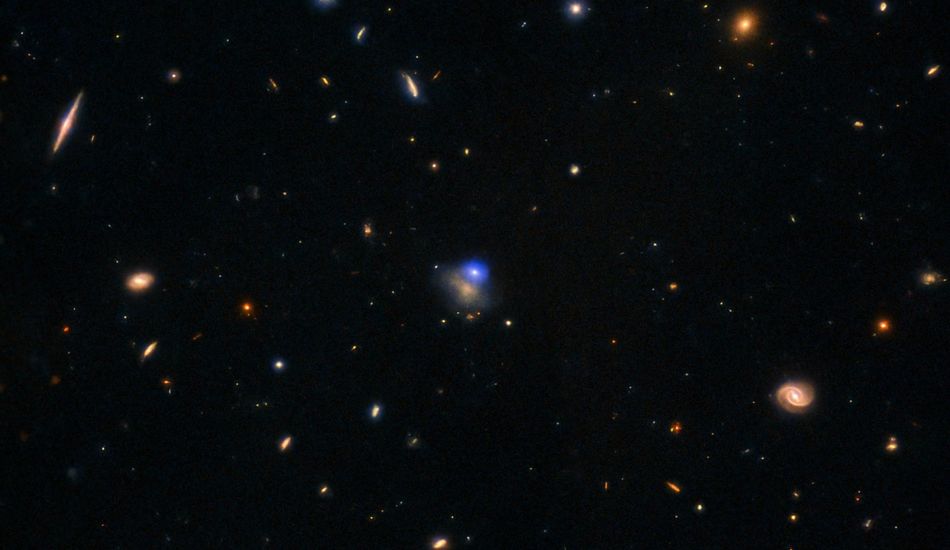
Astronomers Solve Mystery of Ultra-Fast Blue Flashes in Space
The universe is a wild place, isn't it? Scientists are constantly scratching their heads over bizarre phenomena, and sometimes, they actually figure things out! Right now, they may have cracked the case of Luminous Fast Blue Optical Transients (LFBOTs) – those strange, fleeting bursts of blue and ultraviolet light that have puzzled astronomers for years. Sounds like something out of a sci-fi movie, right?
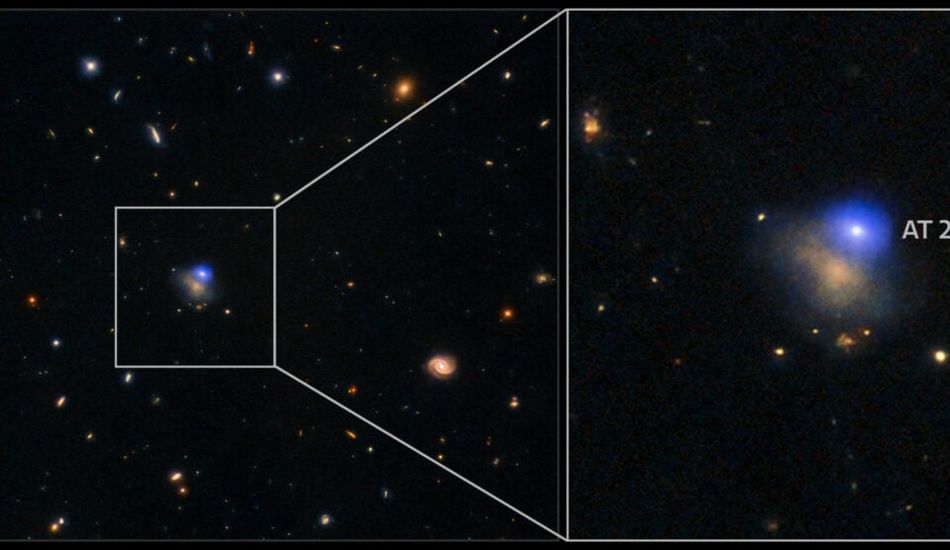
These LFBOTs are pretty rare. I mean, we're talking about flashes so bright they can be seen from billions of light-years away. However, they don't stick around for long; a few days, tops. The first one was spotted back in 2014, and only a handful have been detected since. Last year, a team at the University of California, Berkeley, stumbled upon AT 2024wpp, which is the brightest LFBOT ever observed. Now, after some serious digging, it looks like these blue flashes might be the last gasps of a star being devoured by a supermassive black hole. Talk about a bad day at the office!
The investigation into AT 2024wpp was like an all-hands-on-deck situation. Researchers used a whole arsenal of telescopes – X-ray, radio, and ground-based – to capture as much data as possible. Because AT 2024wpp was so bright, it gave them a unique chance to conduct follow-up observations over several months. As Natalie LeBaron mentioned, LFBOTs are usually too far away to get such detailed information.
Black Hole Mayhem
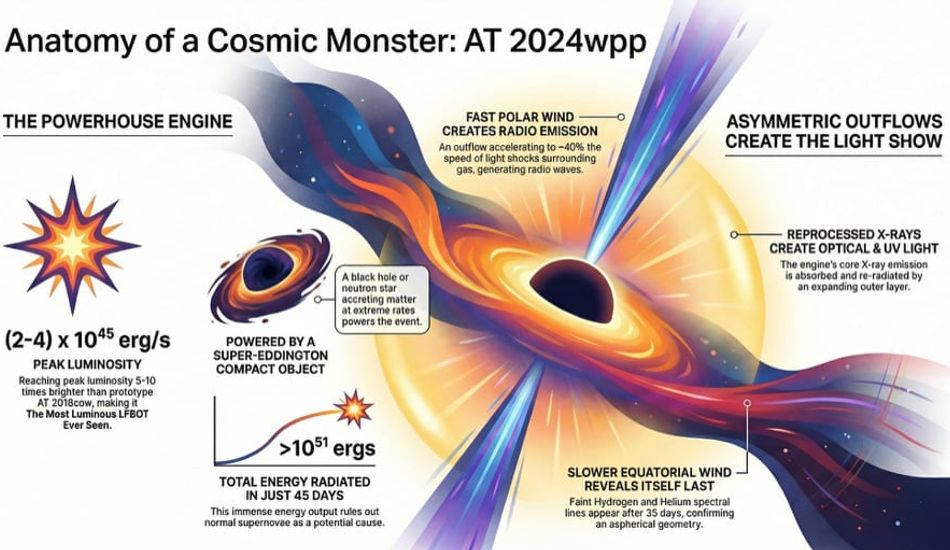
So, what's the deal with these black holes? The leading theory suggests that LFBOTs are the result of "tidal disruption events". Picture this: a massive black hole, hundreds of times the size of our Sun, is slowly draining a nearby star. The star gets too close, and BAM! It's torn apart into a swirling disk of stellar debris. Then, the collisions between this debris and the gas around the black hole create those bright jets of X-ray, ultraviolet, and blue light – the LFBOTs.
It's like a cosmic feeding frenzy, but instead of a quiet dinner, you get a spectacular light show, although I imagine that the star that is being eaten is not enjoying it.
These tidal disruption events are already pretty uncommon, but the ones that cause LFBOTs are even weirder. Nayana A. J. points out that AT 2024wpp evolves so quickly that it allows us to study black holes in a mass range that bridges stellar-mass and supermassive black holes. So it's like a peek into the lives of some seriously heavyweight cosmic players.
For the broader astronomy community, this discovery is a big deal. It shows how powerful it is when telescopes around the world (and in space) work together to unravel these cosmic mysteries. Plus, studying what comes out of a black hole gives us crucial insights into the physics inside and around these enigmatic objects. And with the next generation of telescopes on the horizon, it's safe to say that our understanding of the universe is about to get a whole lot richer.
2 Images of Blue Flashes:
Source: Gizmodo